Archives for category: Uncategorized

Using Google’s Public Data Explorer lets take a look at labor force participation rates and gender. unfortunately I wasn’t able to upload the graphs to this blog directly, but you’re free to verify my findings here

contained in the data-set is this definition for Labor Force Participation Rate:  “Percentage of the working-age population (ages 15–64) that actively engages in the labour market, by either working or actively looking for work. ILO (2010d). [“Key Indicators on the Labour Market: 6th edition”. Geneva: ILO.] Accessed June 2010.” they direct you to this link for further detail: http://hdrstats.undp.org/en/indicators/48906.html

I wondered how a selection of Muslim-majority countries would compare with non-Muslim majority ones, but wanted to retain some measure of development for fairness. I chose the latest UN report measuring the Human Development Index for 2010. The reason I chose to use HDI ranking was to prevent ridiculous scenarios like Afghanistan vs. France. While the HDI is not perfect, it should be sufficient for the task of roughly comparing levels of development.

I like pictures of flags so I created an image of my word table to retain them 😀
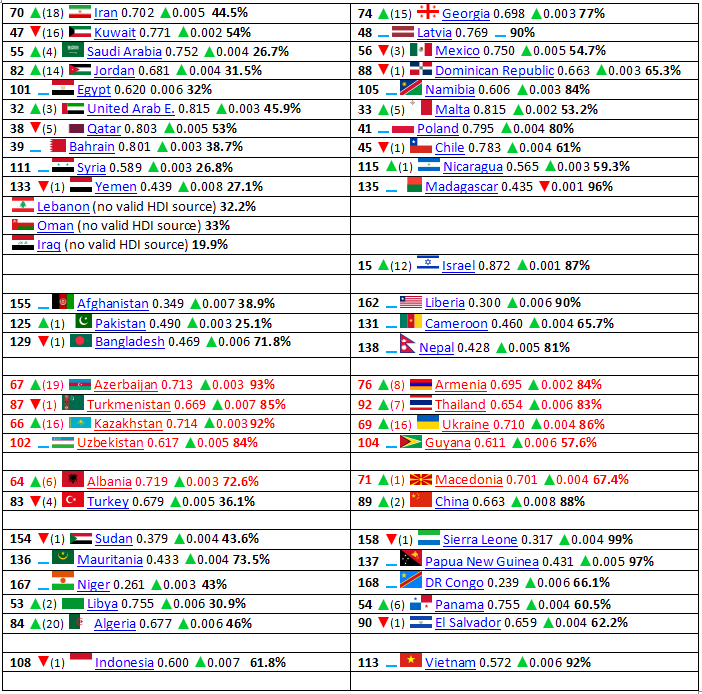
I tried to break down countries by region, using neighboring non-Muslim countries when I could*. I included several Middle Eastern countries that did not have current HDI information just for comparison’s sake. HDI ranking is on the left while the female/male participation ratio is on the right.  Red indicates comparisons where Muslim-majority countries have more female participation in labor than their non-Muslim counterparts.

There are several interesting things we find here. Overall, higher HDI ranking does not imply female participation, in Muslim and non-muslim countries. For example, the US has a ratio of 85% female participation vs. men, while Cambodia has 88% female participation!

At the same time, it would be remiss not to point out that the majority Muslim countries had a lower female participation than their similarly developed non-Muslim counterparts. out of 25 comparisons only 5 showed higher female participation in Muslim countries. In other words, 80% of the Muslim countries had a lower rates of female participation in the labor market.

What’s notable, is that of the five exceptions, all come from former communist states! even Turkey, which has been hailed for its secularism, had a considerably lower rate of female participation. Also notable is the outcome for Bangladesh. Even though it scored lower than Nepal, it ended up beating out a much bigger competitor in India! I didn’t use India as a comparison because the HDI difference was too high, but its worth pointing out that despite its higher development, India’s female participation is very low, at just 42.2%. India was also featured on an earlier list on female literacy. The Economist has an article on sexist attitudes in India that sheds some light on this.

In the Middle East (as defined by an earlier post) the picture more negative than in Bangladesh. Only two Muslim countries there reach 50% female participation and in eight have a 3rd or less participating. Even in oil rich countries like Saudi Arabia and Bahrain where per capita income is high and their HDI is comparable to European countries women are a marginal part of the labor force. The good news is that in many of these countries the rate of female participation is increasing; but unfortunately this trend is not uniform in the region. notably, Egypt, with its recent revolution has gone from having the best levels of female participation in 1980 (ahead of even turkey) to having a below-average participation ratio.

Perhaps more insight could be gleaned from the former communist exceptions in this table as well as Bangladesh.

*there is only one non-Muslim majority country in the middle east and it’s HDI rank is also considerably higher so I didn’t use it for any direct comparisons)

Sadly, the results for East Asia aren’t quite as exciting, or especially validating of my hypothesis. I should note that poorer countries like Mongolia and N. Korea didn’t have complete data so I had to limit my list of countries.


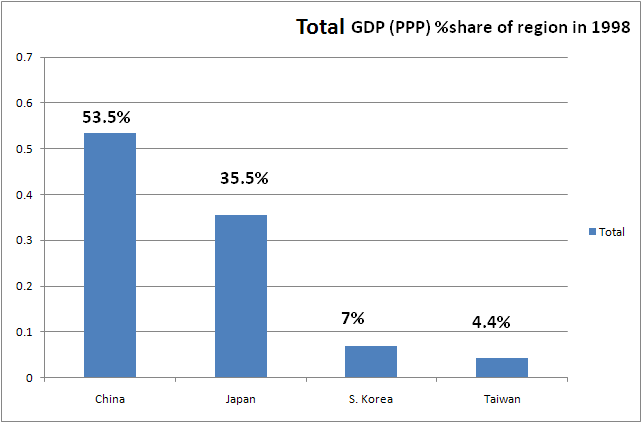
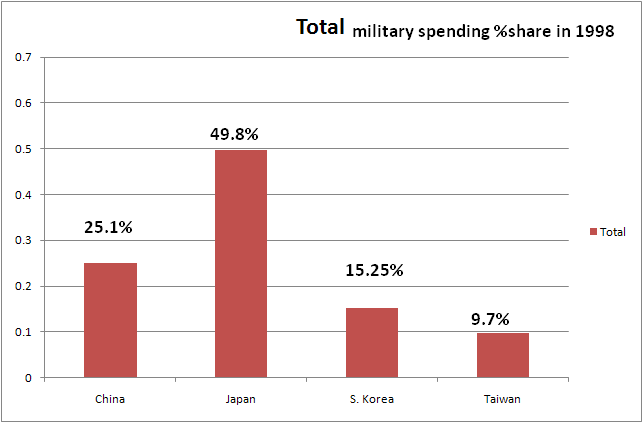
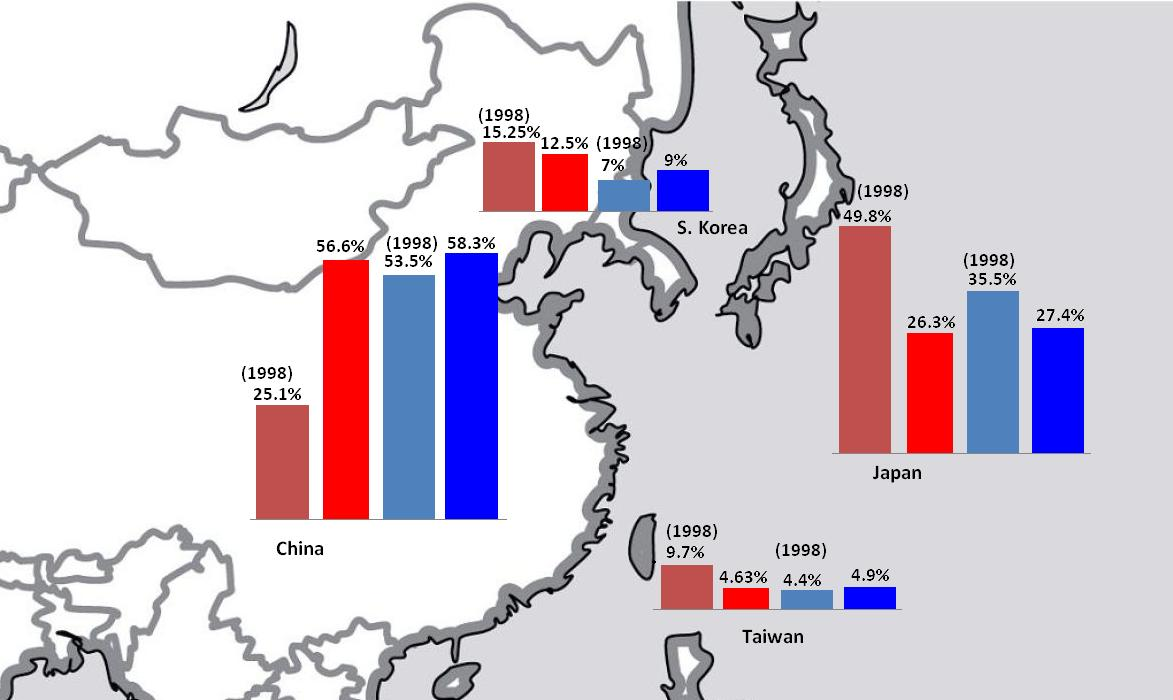
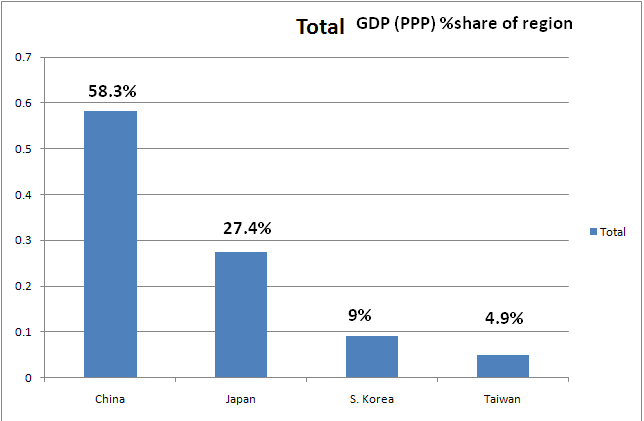
It is interesting to note that SIPRI’s list shows a dramatic climb in China’s military spending over the past 10 years, in 1999 they spent less than a 3rd what they do now. Using http://www.umsl.edu/services/govdocs/wofact99/5.htm I will show the change 11 years has brought East Asia:

Surprisingly, China’s relative economic growth has been minimal, changing just 5% relative to the rest of East Asia. The notable exception of Japan might cause you to wonder do these numbers really add up? They mostly do. The reason China hasn’t improve more is because its own growth has been matched economically by Taiwan and South Korea. But militarily, China now matches its economic might with the majority of all military spending in East Asia. My hypothesis could work, perhaps there was a threshold in individual income in China that passed in the last decade, while the government in Japan saw the national debt and increasing cost of an aging population as a bigger threat than military ones.

I think I’m probably wrong though; there are likely better explanations for relative military spending than GDP per capita alone. for instance, in 1996 the third taiwan strait crisis took place, possibly driving the government in Taipei to continue spending a large amount on its military. In 1998 South Korea began the so-called Sunshine Policy with North Korea, easing tensions in the region as a result. Finally, China itself has seen its direction of trade expand in the past decade; numerous shipping routes have become essential to its globalized economy. Perhaps the relative leap in China’s military spending is mostly an outcome of its increasing trade. In the US the war of 1812 is often hailed by historians as an early example of US economic policy shaping its military and foreign policy perhaps the three fold increase in military spending by China is similar.

One way scholars try to measure power using the Realist paradigm is by focusing on relative power. in these graphs I will be using two metrics: military spending and gdp (ppp).

What becomes puzzling is that some countries have large shares of the GDP yet spend less on their military. Here is my hypothesis (which I will try to resolve later): countries with a high GDP per capita are able to tax their populations/dedicate oil revenues towards military expenditures more because individuals can withstand the cuts in income better. For example, Egypt’s per capita GDP is only $6,200 in 2010, while Israel and the UAE had an income of $29,500 and $40,200 respectively. For some countries, the numbers may not tell the whole story. In Iran there are at least 3 organizations who could be counted under military expenses: the IRCG, the Baseej, and finally their traditional military. SIPRI may have only counted the latter.

Note: I didn’t include Turkey because: a) they haven’t been involved in any interstate conflicts in the middle east in the past 65 years and b) their placement in the middle east isn’t entirely agreed on by middle east experts. (they would also fuck everything up by having an enormous economy/share of military spending).

Total: 33

Majority muslim: 20. 60.7% Over 25% muslim: 5. 15.1% other: 24.2%

Sudan                  61.1%     71.8%    50.5%    4.72

W. and Futuna 50.0%    50.0%    50.0%    no data

Malawi                62.7%     76.1%    49.8%    5.92

Comoros              56.5%    63.6%    49.3%    5.03

India                     59.5%     70.2%    48.3%    2.73

Eritrea                  58.6%     69.9%    47.6%    5.08

Togo                     60.9%     75.4%    46.9%    4.96

Egypt                    57.7%     68.3%    46.9%    2.83

Burundi                51.6%    58.5%    45.2%    6.55

Cote d’Ivoire      50.9%    57.9%    43.6%    4.50

Liberia                  57.5%     73.3%    41.6%    6.02

Mali                      46.4%     53.5%    39.6%    7.42

Morocco              51.7%    64.1%    39.4%    2.68

C.African Rep.   51.0%    63.3%    39.3%    4.41

Chad                     47.5%     56.0%    39.3%    6.25

Pakistan               48.7%    61.7%    35.2%    4.00

Ethiopia                42.7%    50.3%    35.1%    5.22

Nepal                   48.6%     62.7%    34.9%    4.10

Gambia, The      40.1%    47.8%    32.8%    5.30

Mozambique     47.8%    63.5%    32.7%    4.62

Mauritania          41.7%    51.8%    31.9%    5.86

Bangladesh         43.1%    53.9%    31.8%    3.11

Senegal                40.2%    50.0%    30.7%    4.38

Yemen                50.2%     70.5%    30.0%    6.58

Guinea-Bissau   42.4%    58.1%    27.4%    4.86

Somalia                37.8%    49.7%    25.8%    6.76

Iraq                       40.4%     55.9%    24.4%    4.18

Benin                   33.6%     46.4%    22.6%    5.20

Guinea                35.9%     49.9%    21.9%    5.79

Afghanistan        36.0%    51.0%    21.0%    6.69

Sierra Leone       29.6%    39.8%    20.5%    6.08

Burkina Faso      26.6%    36.9%    16.6%    6.47

Niger                    17.6%     25.8%    9.7%      7.46

http://www.mrdowling.com/800literacyfemale.html

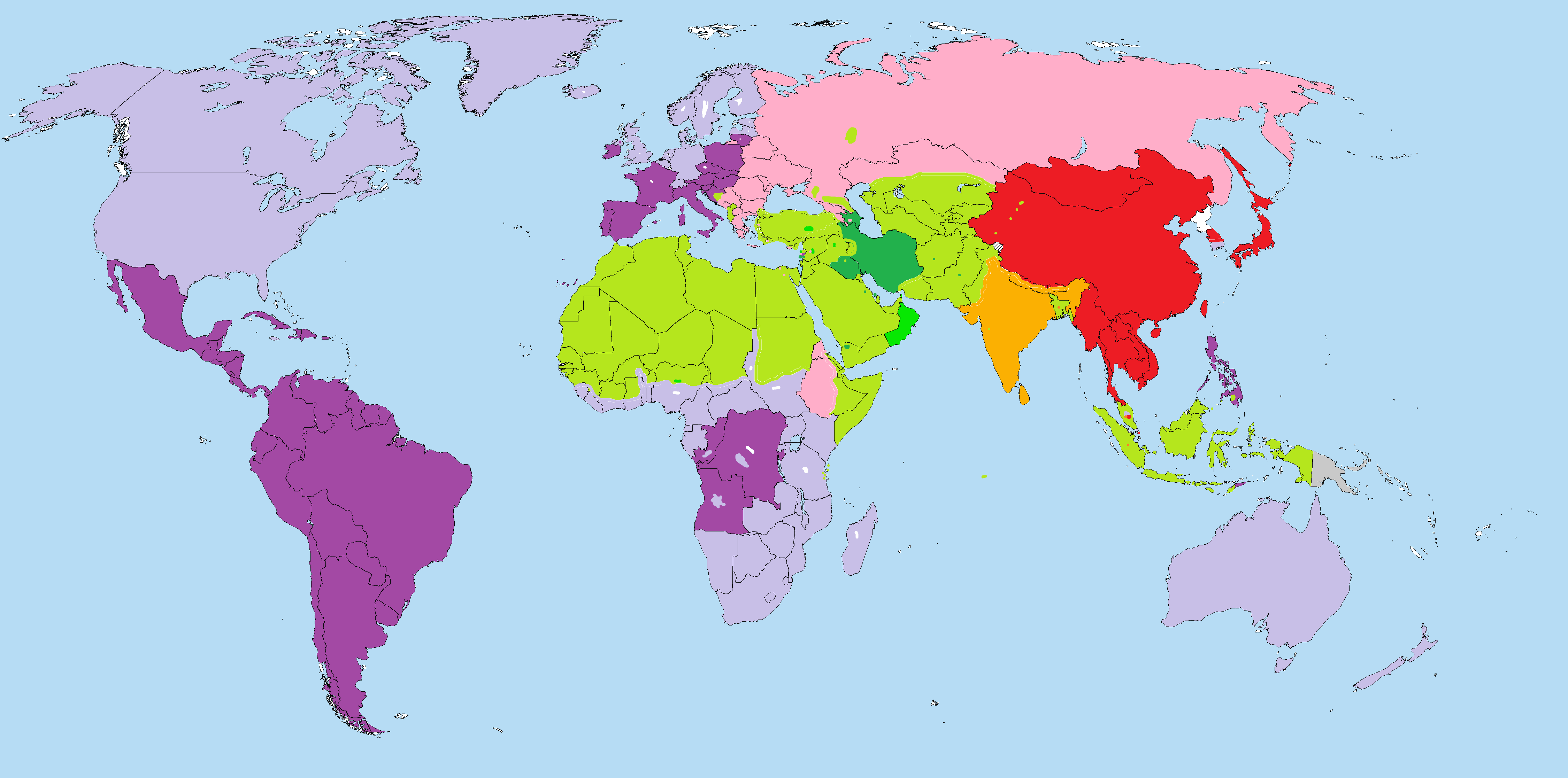
key: yellow=non-china BRIC states, g8 members. blue=US allied states. light red/red= china and chinese allies.